Furnishing a Mountain Home: Scale, Fabrics, and the Timeline Nobody Warns You About
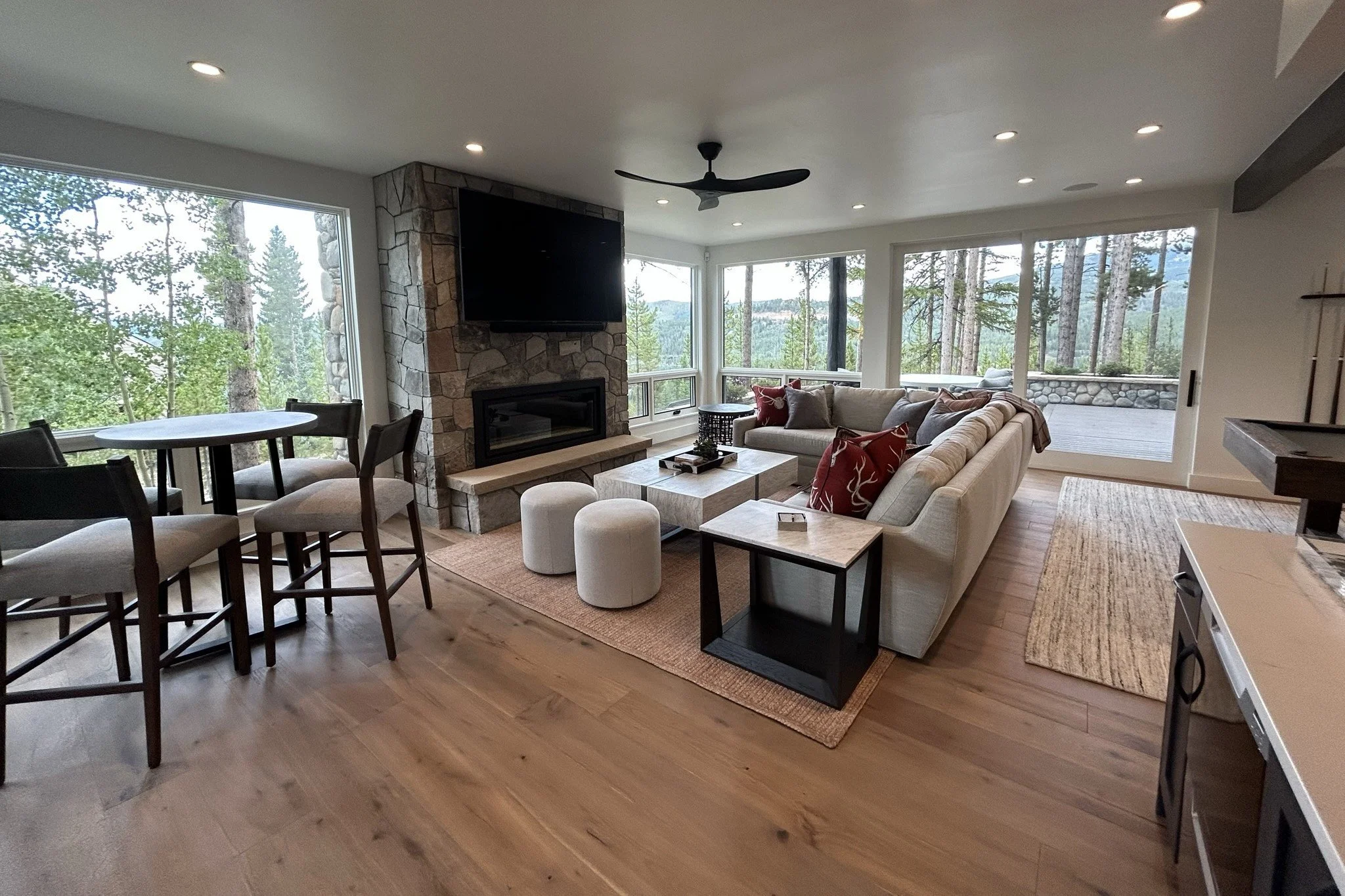
Q: How Do You Furnish a Mountain Home?
Furnishing a mountain home starts with scale: pieces sized to tall, open rooms rather than standard ceilings. From there, it is about materials that stand up to sun, snow, guests, and pets, and a purchasing timeline that starts months before the install date. The best rooms are planned as one project, not collected one purchase at a time.
Most owners get to this stage tired. The build or remodel took longer than promised, the finish decisions felt endless, and furniture looks like the fun part. It is the fun part. It is also the stage where a beautiful house most often stalls, because furnishing a whole home is a bigger logistical lift than almost anyone expects.
Scale First: Mountain Rooms Make Normal Furniture Look Small
The most common furnishing mistake in Summit County homes is a scale mistake, not a style mistake. Great rooms with vaulted ceilings, oversized windows, and open sightlines swallow furniture that would look generous in a city living room. In a mountain modern living room, scale is the difference between dramatic and empty.
A standard sofa floats. A pair of accent chairs disappears. The rug that seemed enormous online ends up reading like a bath mat in front of a two-story stone fireplace.
Getting scale right usually means:
Deeper, longer seating pieces, often in configurations rather than singles
Rugs sized so every front furniture leg lands on them, which in a great room can mean sizes most stores never stock
Lighting brought down to people height, so tall rooms still feel warm at night
Substantial coffee and side tables that hold their own next to bigger seating
Art and window treatments scaled to the wall, not to the piece that fit the last house
Scale decisions and floor plans are inseparable, which is why furniture should confirm a plan rather than rescue one. That thinking is covered in depth in the studio's post on mountain home space planning; this post assumes the plan exists and the shopping is about to start.
Choose Fabrics for the Life the House Will Live
A mountain home is hard on furniture. Intense high-altitude sun pours through big windows and fades fabric. Ski clothes, dogs, firewood, sunscreen, and a rotating cast of guests all take their toll. The upholstery that survives is chosen for that reality, not for the showroom.
This is where a little skepticism helps, because fabric marketing leans hard on one number: the double-rub count. That number means less than the tag implies. The Association for Contract Textiles, the industry body behind the standard, states plainly that higher abrasion ratings do not indicate longer service life, and that results on the same fabric can vary widely between tests. A 100,000 double-rub tag is a marketing line, not a warranty.
What predicts survival in a mountain home:
Fiber content: solution-dyed synthetics and tight wool blends handle sun and friction far better than most delicate naturals
Performance treatments: genuinely cleanable fabrics matter more in a house full of guests than any abrasion score
Color and pattern strategy: mid-tone, textured fabrics forgive what pale solids broadcast
Fade resistance: south- and west-facing seating needs UV-stable fabric, or it will look sun-tired in a few seasons
Leather in the right places: it wears in rather than wearing out, and it shrugs off dogs better than most weaves
None of this has to look institutional. Performance fabrics now come in weaves and textures that read as tailored and warm, which is exactly what a mountain modern room wants.
Mountain Furniture Does Not Mean Mountain Theme
A whole category of modern mountain decor is sold on the promise of looking mountain: heavy log frames, antler hardware, plaid everything. A home furnished from that catalog feels like a rental. The style question is settled elsewhere, in the studio's post on mountain modern interior design, but the furnishing version of the rule is simple: buy pieces for their shape, comfort, and material honesty, not for their costume.
In practice, the mix that works is quieter:
Clean-lined upholstery in tactile fabrics
Wood pieces where the grain, not a carving, is the character
One or two vintage or collected items so the room has a memory
Metal and stone accents that echo the home's finishes
Comfort as a hard requirement, because this is a house people come to so they can relax
A good test before any large purchase: would this piece still make sense if the house were in another state? The answer should usually be yes. The house is already in the mountains. The furniture does not need to say it again.
The Timeline: Furnishing a Mountain Home Runs on Lead Times, Not Weekends
Here is the part that catches nearly every first-time owner: quality furnishings are made to order, and made-to-order means months.
In recent project work, custom upholstery has commonly run two to four months from order to arrival, case goods in a similar range, and hand-knotted rugs longer still. Across a whole home, the run from first orders to installed rooms commonly spans four to nine months. Those windows also move. Trade publication Business of Home has tracked manufacturer lead times swinging from a dozen weeks to nearly a year and back depending on the year and the maker. The only safe assumption is that the piece you love will not be in a warehouse waiting for you.
That is why furnishing a mountain home gets planned backwards:
Set the date that matters, whether that is ski season, a family holiday, or a summer of hosting
Subtract delivery, receiving, and installation time
Subtract the longest lead time in the plan, plus a real buffer
That is the order date, and it is always earlier than it feels like it should be
Ordering everything as one coordinated package, rather than piece by piece over a year, is also what keeps the timeline recoverable: every lead time is known on day one, so nothing surprises the calendar in month five.
Getting It All to the House Is Its Own Project
Furniture logistics are invisible until they are yours. Freight carriers do not carry sofas up a switchback driveway in February. Deliveries arrive damaged and have to be claimed and reordered. Somebody has to receive, inspect, and store forty boxes until install day, because a house cannot function as its own warehouse for three months.
For a Summit County home, that means someone needs to manage:
Order tracking across a dozen or more vendors with different lead times
Receiving and inspection at a warehouse, so damage is caught before install day
White-glove delivery scheduled for mountain roads and mountain weather
A coordinated installation, so the home goes from empty to finished in one push
The punch list afterward, because something always needs a repair, a return, or a swap
This is unglamorous work, and it is precisely the part that turns a furniture plan into a finished home. It is also the part owners are happiest to hand off.
How Elle J Design Handles Furnishings in Summit County
Elle J Design is a full-service space planning and interior design firm based in Summit County, and furnishings are one of its three core services. The studio's custom furnishings work starts with selections and finish samples, then carries the unglamorous middle: quoting, purchasing, and order tracking. It ends with white-glove delivery and installation, coordinated as one install.
In plain terms: the design work decides what belongs in each room and why, and the studio then runs the procurement so orders go in on time, problems get caught at the warehouse instead of the living room, and installation happens as one coordinated event rather than a season of deliveries.
For the studio's clients across Breckenridge, Frisco, Dillon, and the Vail Valley, that is usually the difference between a home that is finished before the family arrives in December and one that is still waiting on a dining table in March.
If you have a Summit County home approaching the furnishing stage, the timeline is the one thing that cannot be recovered later. It is worth starting the conversation with Elle J Design before the calendar makes the decisions for you.
FAQs About Furnishing a Mountain Home
Do You Handle Furnishings for Homes in Breckenridge and Summit County?
Yes. Elle J Design offers custom furnishings as a core service for homes across Summit County, including Breckenridge, Frisco, Dillon, Silverthorne, and Keystone, as well as the Vail Valley. The work includes furnishing selections, quoting and purchasing, order tracking, and coordinated white-glove delivery and installation.
What Fabrics Hold Up Best in a Mountain Home?
In a mountain home, performance fabrics, solution-dyed synthetics, tight wool blends, and leather tend to perform best against high-altitude sun, guests, and pets. Abrasion ratings alone are not a durability promise, so fiber content, cleanability, and fade resistance matter more than the double-rub number on the tag. Before falling for any fabric, ask for its cleaning code and picture it after a holiday week.
How Long Does Furnishing a Mountain Home Take?
For a whole home with custom pieces, plan on roughly three to nine months from first orders to installed rooms, depending on lead times. Individual custom upholstery commonly takes two to four months to arrive, which is why orders are planned backwards from the date the home needs to be ready. Owners usually spend the waiting months on art, lighting, and accessory decisions so install day finishes the whole room.
Does the Furniture Have to Match the Mountain Modern Style?
No. Furniture should fit the home's scale, materials, and the way the owners live, not a style checklist. Most successful mountain modern rooms mix clean-lined new pieces with a few collected or vintage items, and skip themed furniture entirely.
Final Takeaway
Furnishing a mountain home is a project with a critical path, not a shopping trip. Scale decides whether the rooms feel right. Fabric decides whether they survive. The calendar decides whether any of it is ready when the family arrives.
Treat it like the final phase of the build, with the same planning and the same respect for lead times, and the house finishes the way it was drawn: complete, comfortable, and ready for the season it was bought for.